
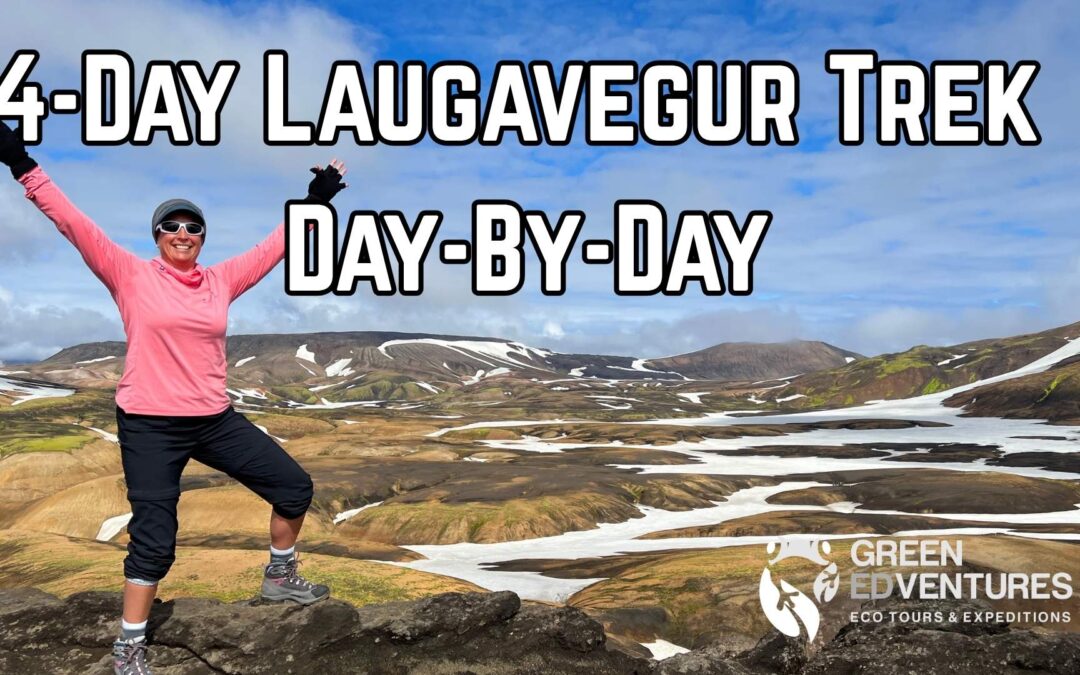
Four days hiking through Iceland’s Laugavegur Trail, an extra day exploring Þórsmörk, and a well-earned soak at Sky Lagoon
By Tara Short | Founder & CEO, Green Edventures Eco Tours & Expeditions
I’m an environmental educator, adventure travel specialist, and your first Edventure Buddy. I’ve spent more than 17 years creating small-group adventures that connect people with nature, local cultures, and one another.
Are you intrigued by Iceland’s Laugavegur Trail but wondering what it’s actually like to hike it? How difficult are the days? What are the huts like? And what happens when you have to cross a freezing glacial river?
I recently hiked the Laugavegur Trail for the 6th time with a group of adventurous women. Although my company has helped women hike the Laugavegur trail 10 different times, this was my first time back on the trail since 2023.
Over four hiking days, we traveled from the colorful rhyolite mountains of Landmannalaugar through obsidian fields, black volcanic deserts, glacial rivers, and finally the green forests of Þórsmörk.
There were lost hiking boots, a spontaneous dance party, a helicopter rescue, lots of laughter, and a few moments I’ll never forget.
Here’s how our seven-day adventure unfolded.
Our Laugavegur Trail Itinerary at a Glance
| Day | Route and activities |
|---|---|
| 1 | Arrive in Reykjavík, meet the group, and prepare |
| 2 | Landmannalaugar to Hrafntinnusker — approximately 7 miles |
| 3 | Hrafntinnusker to Hvangil via Álftavatn — approximately 10–12 miles |
| 4 | Hvangil to Emstrur — approximately 10 miles |
| 5 | Emstrur to Básar, Þórsmörk — approximately 9–10 miles |
| 6 | Optional 5-mile hike in Þórsmörk; return to Reykjavík |
| 7 | Sky Lagoon and departures |
Our four-day Laugavegur hike covered approximately 34–36 miles. We stayed in mountain huts, carried daypacks, and had our duffel bags transported between accommodations.
Our average hiking pace was about 1.3 miles per hour, including breaks. Some days took close to 10 hours, so don’t let the mileage fool you.
Day 1: Reykjavík — Meeting Our Hiking Team
Our group arrives at Keflavík International Airport from across the United States, including Alaska. We also have women from Canada and Australia.
Most of our hikers are over 50. Our youngest is 28, and two women are 73.
I love having a mix of ages and backgrounds. Everyone arrives with different experiences, but we all have one thing in common: we’ve chosen to spend our vacation hiking across Iceland’s Highlands.
After transferring to Reykjavík, we meet at the hotel for our orientation and get organized for the trek.
There are a few practical things I always emphasize before heading into the Highlands.
First, don’t fill your hydration bladder until we reach Landmannalaugar. There’s no point carrying extra water on the bus, and bladders can leak.
Second, protect your warm layers with dry bags or plastic bags. Water can occasionally get into the luggage compartment during Highland river crossings, and the last thing you want is a wet insulating layer.
Finally, charge your phone, camera, and power banks. We won’t have electricity for charging devices during our four nights in the mountain huts.
That evening, we head out for a seafood dinner. Conversations start flowing, and by the end of the night, the women who were strangers a few hours earlier are already getting to know one another.
Tomorrow, the real adventure begins.
Day 2: Landmannalaugar to Hrafntinnusker — Mind Over Matter
Approximately 7 miles | About 2,000 feet of accumulated ascent
We’re at Reykjavík’s BSÍ bus station at 6:30 a.m., loading our duffel bags into the trailer and finding seats on the Highland bus.
There are about 60 passengers, including another group of 16 hikers who will be staying in the same huts as us. We don’t know it yet, but some of these people are going to become part of our story.
Sixty hikers, one toilet
On the way to Landmannalaugar, we encounter our first challenge.
It’s a bank holiday, and our regular bathroom stop is closed. Instead, we pull into a gas station with one toilet for approximately 60 people.
Our guide, Inga, gets on the intercom and tells everyone to move quickly.
“Don’t hang around doing your hair!”
Somehow, we’re all back on the bus in about 15 minutes. Impressive!
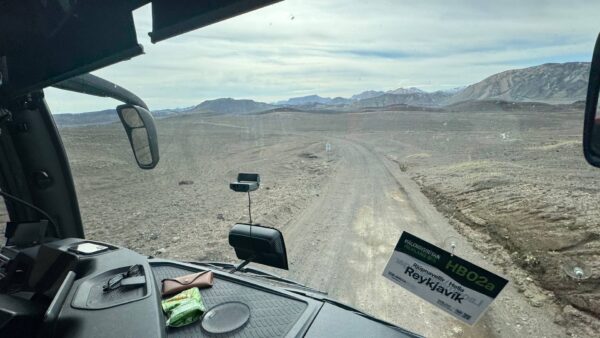
Eventually, we leave the paved roads behind and travel into the Highlands. The bus has enormous tires and is built for rough mountain roads and river crossings. Watching the driver navigate the terrain is exciting enough, and we haven’t even started hiking.
We arrive at Landmannalaugar, eat lunch, use the toilets, and fill our hydration bladders. Some of the women take advantage of the geothermal bathing area before we begin.
The first climb
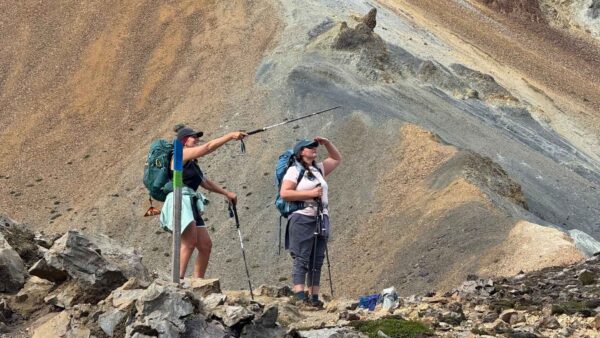
The trail climbs steeply out of Landmannalaugar, and it’s a real introduction to hiking in Iceland.
If you’ve never spent hours climbing uphill, this is where you’ll notice it.
My advice is simple: don’t let your mind race ahead of your feet.
Don’t worry about how you’re feeling now, how you’ll feel in an hour, or whether tomorrow will be harder. Just keep putting one foot in front of the other.
We take breaks, listen to Inga’s stories, and enjoy the views. Before long, the group begins to settle into a rhythm.
The Devil’s Finger and feeling small
Inga offers an optional detour to see the Devil’s Finger, a striking basalt formation rising from the colorful rhyolite mountains.
From above, we can see lava flows, steaming geothermal areas, and tiny hikers making their way through the landscape.
I love moments like this.
In everyday life, we’re constantly encouraged to be bigger, better, and have more. Out here, I feel wonderfully small. I wish I could bottle that feeling and take it home.
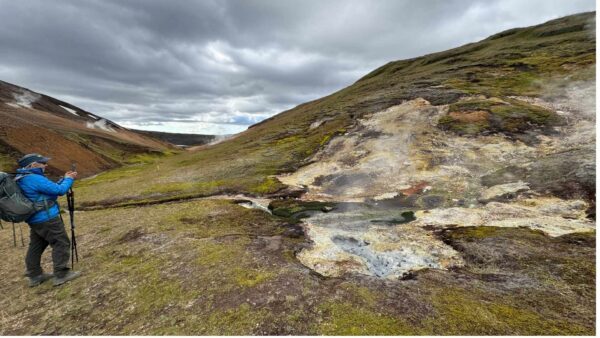
The geothermal areas are fascinating, but they’re not places to wander off-trail. Thin ground can hide dangerously hot water or steam, so we stay on established routes.
Obsidian fields and our first mountain hut
As we climb higher, the colorful rhyolite gives way to black volcanic rock and obsidian.
Obsidian is natural volcanic glass formed when lava cools rapidly. In the sunshine, it glitters across the ground.
I can’t help thinking about Game of Thrones and the White Walkers.
We’re lucky today. Blue skies, sunshine, and no snow on our route. But don’t count on weather like this. Iceland’s Highlands can deliver wind, fog, rain, and even snow during summer.
Eventually, we reach Hrafntinnusker.
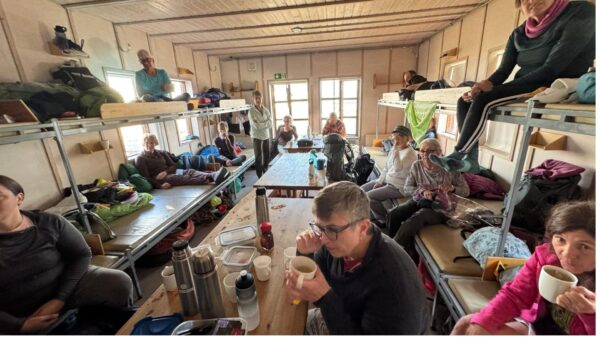
This is one of my favorite huts. Our downstairs sleeping room accommodates about 18 people, with single upper bunks and double lower bunks where hikers sleep side by side.
There are two sinks and two stovetops for the entire hut, so the kitchen is busy. Our guides organize dinner and cleanup, and tonight we’re having lamb soup.
There are no showers, just cold-water sinks and some rather stinky pit toilets.
But standing outside, surrounded by mountains, volcanoes, and glaciers, I couldn’t care less.
What a place to spend the night.
Day 3: Hrafntinnusker to Hvangil — Lost Boots and a Helicopter Rescue
Approximately 10–12 miles | A long day with steep descents
Our morning starts with packing our duffel bags, cleaning our sleeping room, and preparing to leave.
There’s a small gear room near the entrance where everyone stores their hiking boots. Imagine approximately 45 pairs of boots piled into one crowded space.
And then Megan announces:
“I can’t find my boots. I think someone stole my boots!”
The only pair remaining looks similar, but they’re men’s boots, slightly larger, with different-colored laces.
Megan puts them on and, to her credit, doesn’t make a fuss. In fact, she announces that these boots might be more comfortable than her own.
A dance party before breakfast
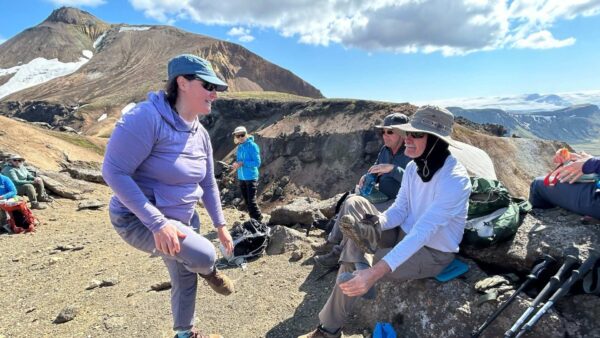
It’s another sunny morning, and we’re standing outside in T-shirts and tank tops.
What starts as a few stretches turns into a spontaneous dance party. Arms are swinging, hips are moving, and everyone is laughing.
Gosh, it feels good to move!
After yesterday’s climb, our bodies are stiff, and this is exactly what we need.
Then we’re off.
Downhill doesn’t mean easy
Today’s route is generally downhill, but that doesn’t mean it’s easy.
We’re constantly climbing and descending through gullies, crossing snow patches, and navigating narrow switchbacks.
Inga checks snow bridges before we cross and coaches us through some of the trickier sections. Trekking poles are especially helpful on the steep descents.
Eventually, we reach a viewpoint overlooking Lake Álftavatn.
This might be my favorite view of the entire hike.
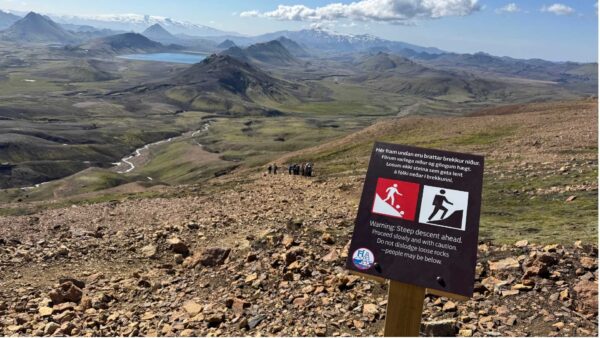
Below us are green valleys, pyramid-shaped mountains, black volcanic landscapes, and distant glaciers. There are no buildings or roads in sight.
We stop for lunch, and I find myself wishing I could spend an hour here every day.
There’s so much suffering and turmoil in the world, but for a little while, sitting above this lake, I feel calm and completely connected to the landscape.
The mystery of Megan’s boots is solved
As we continue hiking, we pass another group.
Suddenly, someone spots a familiar-looking pair of boots.
“Megan, aren’t those your shoes?!”
Sure enough, they are.
And they’re being worn by a man named David.
David had accidentally taken Megan’s boots from the crowded hut that morning. He knew something was wrong when he put them on, but he’d started hiking anyway.
Unfortunately, Megan’s boots were too small for him, and her custom insoles made them even tighter.
By now, his feet are miserable.
They exchange boots, everyone bursts into laughter, and Megan admits she actually preferred David’s.
The two hug like old friends.
From that moment on, David becomes part of our trail experience. Whenever we see him, someone calls out hello.
Later, we learn that David’s wife had died and that they had planned to hike the Laugavegur Trail together.
I’d like to think she had a little something to do with the boot mix-up. Maybe she wanted him to laugh, make a few friends, and have a little fun on the trail they were supposed to share.
I certainly hope so.
The descent that changed our day
Ahead is one of the most difficult descents of the trek.
The trail is steep, dry, and covered in loose gravel. The rocks slide beneath our feet, almost like walking through mud.
We’re moving slowly, concentrating on each step.
After reaching a flatter section, I look back and see a man from another group slip backward and land on his backside.
At first, it doesn’t seem especially serious. But several minutes pass, and he hasn’t gotten up.
Something is wrong.
Inga heads back up the slope to help.
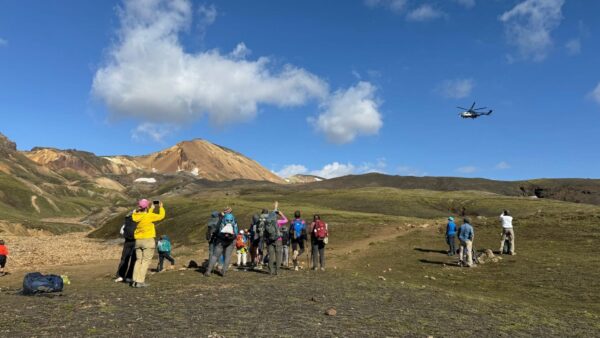
We eventually learn that the man has broken his leg. A rescue helicopter arrives, lowers a basket, and evacuates him from the mountain.
That accident changes the mood.
We all know how easily it could have been one of us.
The rescue delays us by approximately two hours. The injured hiker’s guide stays with him during the evacuation, while Inga helps lead the remaining hikers onward.
Beer, Pringles, and a very long walk to Hvangil
After the stress of the rescue, Inga decides we need a morale boost.
So we stop at the Álftavatn hut bar.
Beer, wine, Pringles, and junk food. Perfect!
We relax for a little while before continuing toward Hvangil.
By now, the day feels endless. I joke that we might as well keep walking to Emstrur!
When we finally reach our hut, everyone is ready for dinner and a good night’s sleep.
What a day.
Day 4: Hvangil to Emstrur — Black Sand and Freezing Rivers
Approximately 10 miles | Exposed volcanic terrain and a glacial river crossing
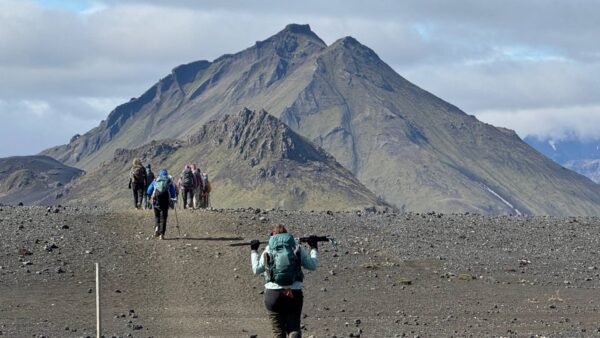
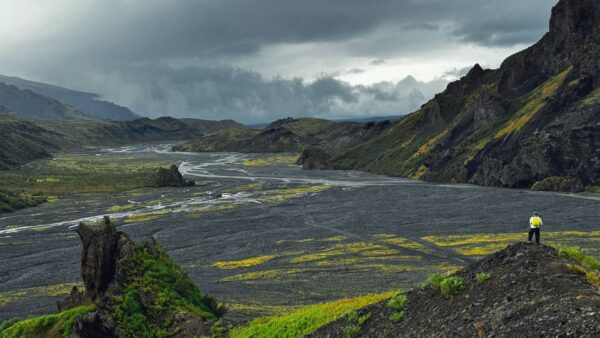
Today, we’re walking across a vast black volcanic landscape known as a sandur.
A sandur is a glacial outwash plain formed when meltwater carries sand, gravel, and sediment away from glaciers. Iceland has some extraordinary examples, shaped by glaciers, volcanoes, and powerful floods.
At first glance, the landscape looks empty.
But there’s so much to discover if you pay attention.
Volcanic bombs and flowers in the desert
We see fascinating volcanic rocks, including formations known as volcanic bombs.
These are pieces of molten or partly molten rock thrown into the air during eruptions. Some develop unusual rounded or twisted shapes as they cool.
And then there are the flowers!
In sheltered patches, we find Arctic river beauty, also called dwarf fireweed. Its pink-purple flowers stand out against the black volcanic ground.
I love these little surprises.
This is one of the things I enjoy most about hiking slowly enough to notice what’s around us.
Icelandic wind is no joke
Today’s route is relatively flat, but it’s also exposed.
On another hike in this area, I experienced a gust of wind so strong that it lifted my backpack and shifted me sideways.
Only about an inch, but enough to get my attention!
That’s Iceland for you.
Fortunately, today we’re making steady progress toward Emstrur.
Crossing the Bláfjallakvísl
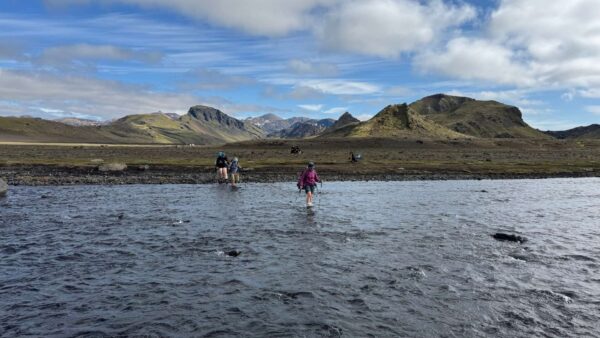
Our big challenge today is crossing the Bláfjallakvísl, a glacial river.
Here’s something you should know about Icelandic glacial rivers: you often can’t see your feet.
The water is cloudy with fine glacial sediment, and the rocks beneath your feet can shift. The current can also be stronger than it looks.
Inga evaluates the water depth, current, and riverbed before deciding where we’ll cross.
We prepare our footwear, secure our hiking boots to our backpacks, and loosen our hip and chest straps so we can release our packs quickly if necessary.
Some women wear river sandals with neoprene socks. Others prefer different secure water footwear. Whatever you choose, make sure it stays on your feet and provides good traction.
Depending on the water depth, you may be able to roll up your hiking pants. Other times, you need to change into shorts or something else that can get wet.
We cross in small groups, following Inga’s instructions.
My river-crossing trick
I have a little trick for dealing with nerves during river crossings.
I sing.
Yes, really.
Something simple and familiar, like Row, Row, Row Your Boat.
It gives my mind something to focus on besides the freezing water and the current pushing against my legs.
Of course, you still need to pay attention to your guide and your footing. And if you’re struggling, say something immediately.
Sometimes we link arms with a buddy, depending on the conditions and the technique our guide recommends.
I also try to focus on the opposite bank rather than staring down into the moving water.
There’s always a sense of accomplishment when everyone reaches the other side.
The Markarfljót canyon
As we approach Emstrur, Inga gives us a choice.
We can head straight to the hut or take a little detour to see Markarfljót canyon.
My advice?
Go to the canyon!
The river has carved an enormous gorge through the volcanic landscape, exposing layers of rock and creating one of the most dramatic views of the day.
It’s worth the extra effort.
Grilled salmon and very cozy sleeping quarters
Tonight, we’re having grilled salmon. Delicious!
Our sleeping room at Emstrur is the smallest of the trip.
We’re sharing with three other hikers: an Australian couple and a traveler from North Carolina. Everyone is friendly and flexible, which is a good thing because there isn’t much room.
By now, we’ve learned to be efficient with our belongings and respectful of one another’s space.
Mountain hut life isn’t luxurious. There are shared sleeping areas, limited privacy, and very little room to spread out.
But that’s part of the experience.
Tomorrow is our final day on the Laugavegur Trail.
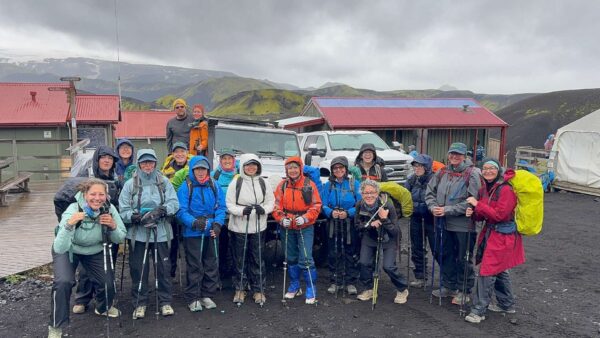
The group leaving Emstur. The luggage transfer vehicle and trailer are behind us.
Day 5: Emstrur to Básar — No Blisters and the Return of the Forest
Approximately 9–10 miles | River canyons, basalt columns, and our final glacial river crossing
It’s our final hiking day, and I’m thrilled to report that I DON’T HAVE ONE BLISTER!
After 35 years of hiking in size 9 boots, I recently discovered that my feet have grown. Apparently, perimenopause can bring surprises, including changes in foot size. Who knew?
I went up half a size, and what a difference.
I’m also feeling really strong today.
I’ve been paying attention to hydration and electrolytes, and I specifically trained for this hike with running, weightlifting, and time on the trails.
That preparation is paying off. I can actually enjoy the scenery instead of wondering how much farther we have to go.
This is why I encourage women to train before hiking the Laugavegur Trail.
Can you will your way through a difficult hike? Sometimes. But why make it harder than it needs to be?
It’s so much more enjoyable when you feel strong.
Deep canyons and basalt columns
Today’s hike takes us alongside a deep river canyon.
There are no guardrails up here, so you need to pay attention to where you’re stepping.
We also see beautiful basalt columns. These geometric formations develop when cooling lava contracts and fractures, often forming five- or six-sided columns.
I never get tired of Iceland’s geology.
The black landscape turns green
One of the most remarkable things about the Laugavegur Trail is how dramatically the scenery changes.
Yesterday, we were walking across black volcanic deserts.
Today, the vegetation is returning.
First come tiny woolly willows, some only a couple of inches tall. Then dwarf birch, grasses, and increasingly lush patches of green.
It’s August, but autumn is already making an appearance.
Wild geranium leaves are turning red, and some lichens add yellow to the landscape.
As we approach Þórsmörk, we can see thick birch woodland across the valley, with some trees already turning gold.
What a contrast to the treeless Highlands!
Why are there so few forests in Iceland?
Þórsmörk means Thor’s Forest, and it’s one of Iceland’s most beautiful woodland areas.
When Norse settlers arrived in Iceland, they cleared large areas of native forest for farming, fuel, and building materials.
Sheep grazing and erosion made it difficult for many of those forests to recover.
Today, woodland conservation and grazing management have helped protect vegetation in areas such as Þórsmörk.
The valley contains native birch, willow, and other plants, along with some planted conifers.
It’s a popular place for Icelanders to camp and hike during the summer.
Standing above the valley, looking at the forest below, I can hardly believe we’re in the same country we started hiking through four days ago.
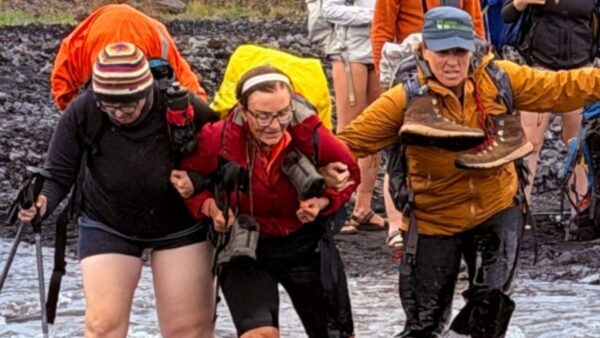
Our final river crossing: The Þröngá
By now, we’re getting pretty good at preparing for river crossings.
But today, Inga shares a brilliant tip I’ve never heard from another guide.
Take off your hiking pants and put on your rain pants!
What a great idea.
The rain pants don’t keep you completely dry when submerged, but they help shield your legs from the freezing water.
I’m among the last to cross, together with two other women.
The river isn’t particularly high today, but the current is strong.
We move carefully, supporting one another. At one point, all three of us lose our balance a little.
For a moment, we’re unsteady, but we manage to right ourselves.
I keep my eyes focused on the opposite bank.
One step at a time.
Luckily, there’s only one main channel to cross today. Sometimes the Þröngá is braided into several channels, meaning hikers have to navigate multiple streams separated by gravel bars.
When we finally reach the opposite bank, I’m relieved.
That’s our last major glacial river crossing!
The hills that never end
You’d think we’d practically be finished by now.
Not quite.
We continue through forest trails and over hills that seem to go on forever.
Eventually, we cross another river on a movable bridge and make our way toward the Básar hut, nestled between towering mountain peaks.
Þórsmörk looks like a movie set.
The landscape is almost unreal.
After days of black volcanic deserts, steaming geothermal areas, and exposed mountains, we’re surrounded by trees, green valleys, and enormous peaks.
We’ve made it.
A speech and a surprise for everyone
During those final miles, I begin writing a speech in my head.
I want to recognize what these women have accomplished.
Four days ago, many of us were strangers. Since then, we’ve climbed mountains, crossed freezing rivers, shared crowded sleeping quarters, laughed, danced, and helped one another through difficult moments.
When we arrive at Básar, Inga and I gather everyone together.
I begin with President John F. Kennedy’s famous words about choosing to do difficult things, not because they’re easy, but because they’re hard.
Then I surprise everyone with a custom-made gift to commemorate our trek. What was the gift? You have to come on the trek to find out?
I’ll share more of what I said at the end of this story, because those words have stayed with me.
Grilled lamb and an emotional update
That evening, we celebrate with grilled lamb.
But there’s one more story from our hike that isn’t finished.
Remember the man who broke his leg on the steep descent toward Álftavatn?
One of his hiking companions comes over to give us an update.
I recognize him from the day of the accident. When his friend was injured, he’d tried several times to climb back up the slippery slope to help. He’d fallen repeatedly himself, and eventually we’d encouraged him to wait with us.
Now he’s standing in front of us, scratched up and wearing bandages.
He tells us that his friend is in good spirits, but the broken leg has been confirmed, and he’ll need to return home for surgery.
As he shares the news, tears fill his eyes.
He explains that he’d been the one who talked his friend into doing the Laugavegur Trail.
And now he feels responsible.
My heart goes out to him.
We reassure him that he couldn’t have known what would happen. They’d chosen to take on this adventure together, and accidents can happen even when people prepare and take precautions.
I think about how easily any one of us could have slipped on that same descent.
For a few moments, the celebration becomes quiet and emotional.
Then the evening continues, with everyone grateful that the injured hiker is receiving medical care.
It’s a moment I won’t forget.
Day 6: Þórsmörk to Reykjavík — One More Hike!
Optional 5-mile hike | Canyon, waterfalls, wild berries, and a Highland bus adventure
After four days on the Laugavegur Trail, you might think we’d be ready to put our hiking boots away.
Not quite!
Some of us join Inga for another five-mile circuit through Þórsmörk.
And I’m so glad we do.
She takes us to another beautiful canyon, surrounded by mountains and little waterfalls spilling down the slopes.
Along the way, we snack on wild crowberries and blueberries.
We stop for lunch in a cave.
I love this moment.
The sound of the river, the calls of redwings, and the chatter of happy women.
Small waterfalls tumble down the mountainsides around us.
There’s nowhere else I need to be.
The bus ride is another adventure
That afternoon, we board our Highland bus for the trip back to Reykjavík.
The road out of Þórsmörk crosses several large rivers, and watching our driver navigate them is thrilling.
The bus enters the water, the current rushes around us, and everyone watches to see what happens.
When we make it safely to the opposite bank, the whole bus cheers!
Then we do it again.
And again.
Each crossing gets another round of applause.
What a fun way to leave the Highlands.
By evening, we’re back in Reykjavík, where we gather for a celebratory dinner.
And for dessert?
Gourmet hot chocolate.
After all those miles, I think we’ve earned it.
Day 7: Sky Lagoon — Soaking Away the Aches
Our final day together is all about relaxation.
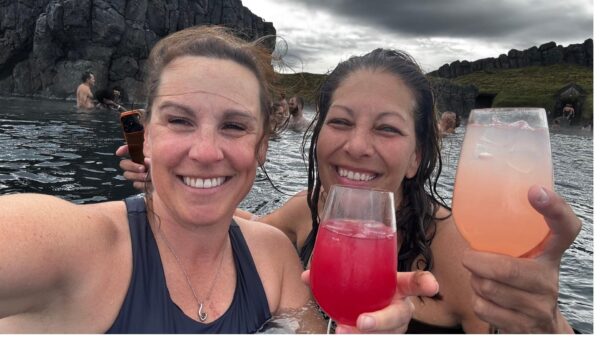
We’re heading to Sky Lagoon, a geothermal spa near Reykjavík overlooking Skerjafjörður bay.
After four days hiking the Laugavegur Trail and another five miles in Þórsmörk, I can’t think of a better place to spend our final hours together.
We settle into the warm infinity pool with colorful drinks and enjoy the ocean views.
Then it’s time for the seven-step Skjól ritual.
My favorite sauna in Iceland
The ritual begins in the warm lagoon, followed by a cold plunge.
That certainly wakes you up!
But my absolute favorite part is the dry sauna.
The enormous window overlooks the bay, and the view is spectacular.
I absolutely LOVE this sauna.
Afterward, we move through a cool mist, a salt body scrub, and a warm steam room, followed by the ritual’s final elixir.
Then it’s back to the lagoon.
There’s even a waterfall where the cascading water massages your shoulders. After carrying a daypack and using trekking poles for several days, that feels especially good.
We spend our final moments floating in warm water, talking, laughing, and enjoying the view.
Soon, everyone will head to the airport.
A week ago, most of us didn’t know one another. Now we have seven days of stories, inside jokes, and shared experiences.
What a lovely way to finish our adventure.
What You Should Know Before Hiking the Laugavegur Trail
If this adventure has you thinking about hiking the Laugavegur Trail yourself, there are a few things I’d want you to know.
It’s challenging, even with luggage transportation
We hiked approximately 34–36 miles over four days, with long climbs, steep descents, loose volcanic rock, and freezing glacial rivers.
Our average pace was about 1.3 miles per hour, including breaks, and some days took close to 10 hours.
Having our duffel bags transported meant we only carried daypacks, but we still needed to be physically prepared.
Mountain huts are basic
Expect shared sleeping rooms, limited privacy, and very little space to spread out your belongings.
Bring comfortable hut clothes, a lightweight sleeping bag, earplugs, and a sleeping mask. Packing cubes are especially helpful.
Some huts have showers, while others don’t. Don’t count on being able to charge your devices.
For more advice, read our Laugavegur Trail Packing List: Essential Gear and Practical Tips.
Age isn’t the deciding factor
Two women on our trek were 73.
But age alone doesn’t tell you whether someone is ready for this hike.
What matters is your fitness, hiking experience, mobility, balance, and willingness to prepare.
If you have painful or unstable knees, struggle with uneven terrain, or aren’t comfortable hiking for hours in difficult weather, this may not be the right trek for you.
For training advice, read Can I Hike the Laugavegur Trail? Fitness, Difficulty & What to Expect.
A guide makes a difference
I can’t say enough about having experienced local guides who understand the terrain, weather, and river conditions.
Inga’s knowledge, humor, and practical advice made a real difference throughout our trek.
On Green Edventures’ guided women’s Laugavegur hikes, we focus on preparation, small groups, local expertise, and supporting one another along the way.
But I never want anyone to mistake a supported trek for an easy one.
This is real wilderness.
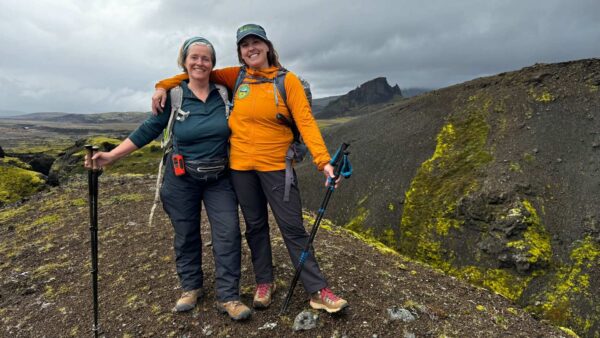
Pictured left is Inga, Icelandic trekking guide, and right is Tara Short Green Edventures’ Tour Leader and author of this blog.
Final Thoughts: We Choose to Do Hard Things
Standing outside the Básar hut, surrounded by the mountains of Þórsmörk, I gathered the women together for a few words.
I started with JFK’s famous speech about choosing to do hard things, not because they’re easy, but because they’re hard.
And that’s exactly what we’d done.
We’d climbed mountains, crossed freezing rivers, slept in crowded huts, and hiked through some of the wildest landscapes in Iceland.
We were tired, a little sore, and probably smellier than we’d like to admit.
But look what we’d accomplished!
The part of my speech that stays with me most is this:
None of us were forced to be here. We all just said yes.
And I’m so glad we did.
Ready to Hike Iceland’s Laugavegur Trail?
If you’ve been thinking about hiking the Laugavegur Trail with a group of women, we’d love to help you decide whether this adventure is right for you.
Green Edventures’ guided Laugavegur treks include experienced local guides, luggage transportation, mountain hut accommodations, and a small group of women who share a love of nature and adventure.
Explore our Women’s Laugavegur Trail Hiking Tour for upcoming departures, fitness requirements, and availability.
About the Author: Tara Short
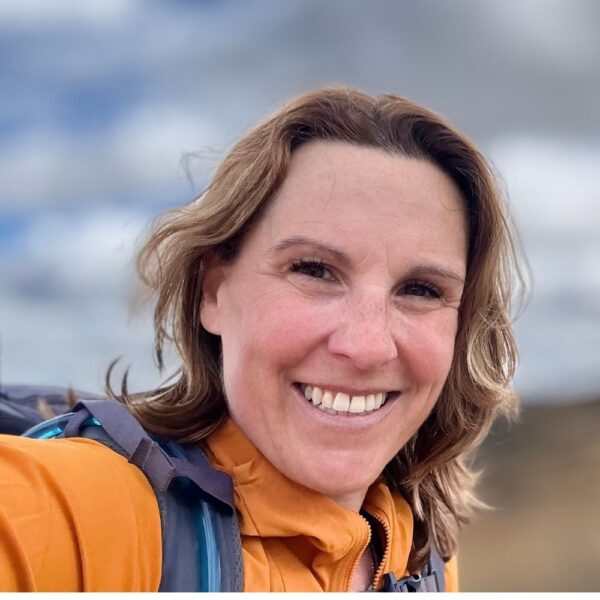
Tara Short is the founder and CEO of Green Edventures Eco Tours & Expeditions, a small-group adventure travel company founded in 2008.
An environmental educator and former naturalist guide in the Bahamas and Costa Rica, Tara has spent more than 17 years creating educational adventures that connect travelers with wildlife, geology, local cultures, and one another.
Today, she specializes in small-group adventures for women, including hiking expeditions, multisport adventures, wildlife experiences, and cultural journeys in destinations such as Iceland, Greenland, Alaska, Baja California, and East Africa.
Based in Chicago, Tara runs, cycles, lifts weights, and believes that preparation and curiosity open the door to extraordinary experiences at any age.
Learn more about our All women Iceland Laugavegur Trek at Green Edventures.
Some names have been changed to protect hikers’ privacy.