
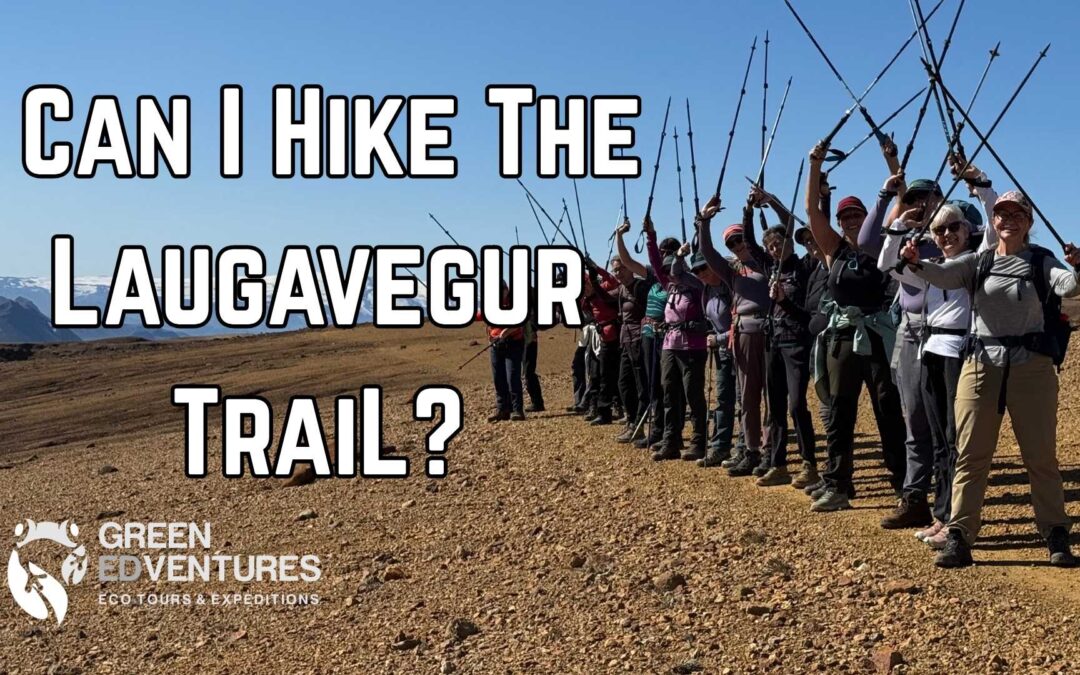
By Tara Short | Founder of Green Edventures | Leading women’s adventures since 2009 and leading groups on the Laugavegur Trail since 2021.
Are you intrigued by Iceland’s Laugavegur Trail but unsure if you can do it?
You’re not alone. It’s one of the questions women ask me most often. Am I fit enough? Will I keep up? Am I too old? Having guided women on this trail since 2021, I’ve seen firsthand what makes this hike challenging and what helps women succeed. Let’s talk about the fitness, preparation, and mindset you’ll need to decide if Laugavegur is right for you.
Can I hike the Laugavegur Trail if I’m over 50? Am I fit enough? What if I’m the slowest woman in the group?
These are some of the most common questions women ask me before joining our guided Laugavegur hike in Iceland.
My answer is often, “Yes, you can. And here’s why.”
But I also believe in being honest about what this trek requires.
Laugavegur is a challenging multi-day hike through Iceland’s remote highlands. You’ll climb mountains, descend steep slopes, cross glacial rivers, and spend hours walking across rocky, uneven volcanic terrain. The weather can change in minutes.
You don’t need to be an elite athlete. But you do need to prepare.
I’ve led women in their 50s, 60s, and 70s on this trail. The oldest woman I’ve taken was 73 years old. I’ve also seen much younger hikers struggle.
Age alone doesn’t determine whether you can complete Laugavegur. Your fitness, hiking experience, balance, health, preparation, and attitude matter much more.
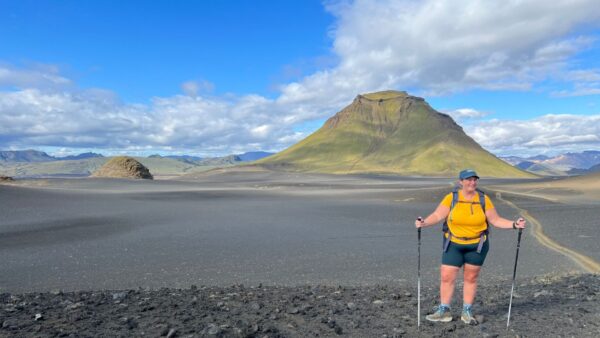
Here’s what I want you to know before deciding whether this adventure is right for you.
Am I Too Old to Hike Laugavegur?
Absolutely not. I don’t even know how old you are, but let’s talk about what that really means.
The oldest woman I’ve taken on the Laugavegur Trail was 73 years old.
Women who join us in their 70s are generally already hikers. They know their bodies, understand their limitations, and have experience spending time on trails.
A woman in her 70s may not walk as fast as a woman in her 30s, but on our trek, speed isn’t the goal.
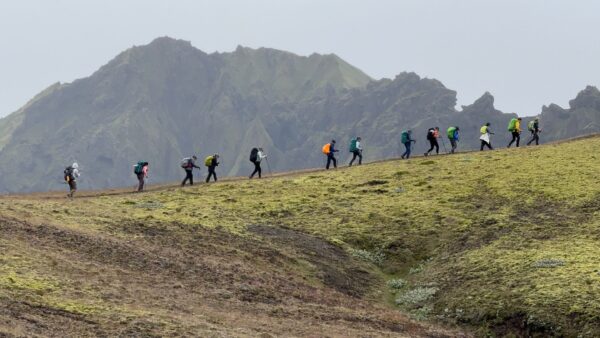
We generally hike at an average moving pace of about 1.3 miles per hour. Our local hiking guide leads from the front, and our Green Edventures tour leader brings up the rear.
For women over 50, I pay much more attention to their knees, cardiovascular fitness, balance, stability, and ability to navigate uneven terrain than their age.
You need functional joints, good balance, and the ability to judge your footing and depth on uneven ground.
And you can train for this trek even if you live somewhere without mountains.
I know because I’m from Chicago.
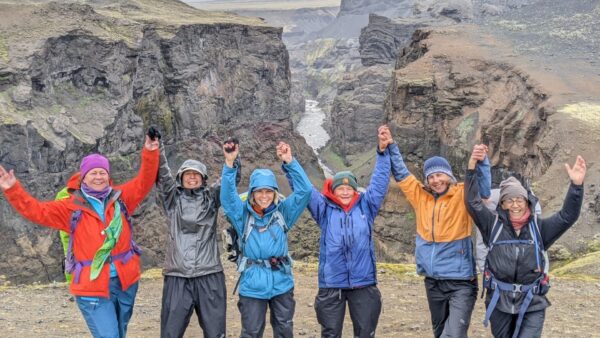
How Fit Do I Need to Be to Hike Laugavegur?
Let’s say you’re 58 years old. You walk three miles a day, occasionally hike on weekends, and do some strength training.
Could you hike Laugavegur?
Possibly, yes. And if you have five months to prepare, you may have enough time to build the endurance and strength you need.
But before encouraging you to sign up, I’d ask a few questions.
Have you ever hiked in mountains? Have you spent long days hiking on uneven terrain with a backpack? How is your overall health? Do you have any problems with your knees, ankles, hips, or balance?
Laugavegur doesn’t reach the extreme altitudes associated with high-altitude mountaineering. The highest part of the trail is around 3,500 feet above sea level. Altitude sickness generally isn’t the primary concern.
The challenge is the terrain, elevation changes, weather, and repeated days of physical activity.
You should be able to hike for several hours while carrying a daypack, manage steep ascents and descents, and recover well enough to do it again the following morning.
Being fit enough for Laugavegur isn’t about how fast you can walk. It’s about whether you can keep going, day after day, safely and comfortably enough to enjoy the experience.
How Difficult Is the Laugavegur Trail?
I consider Laugavegur a challenging hike, particularly for women who have never completed a multi-day trek.
The trail isn’t technical mountaineering, but it is physically demanding.
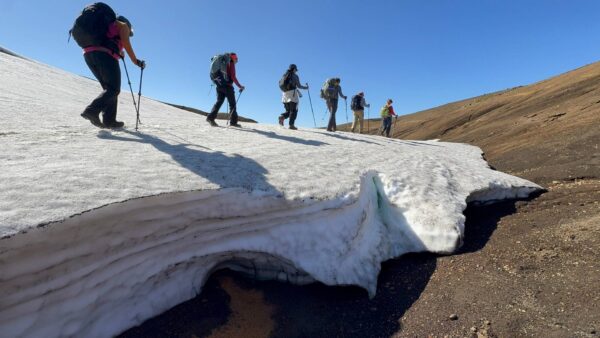
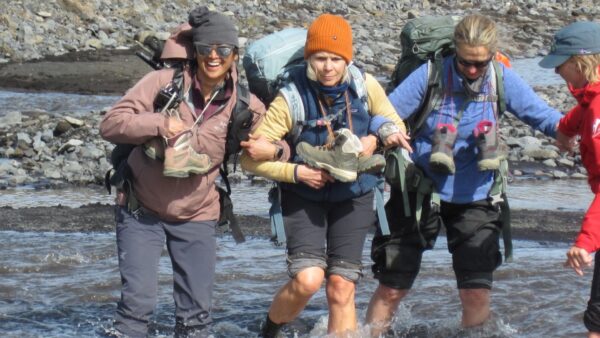
You’ll encounter steep climbs and descents, loose volcanic rocks, snow patches, exposed ridges, glacial rivers, and long stretches without shelter.
The first two hiking days can be especially challenging because of the elevation changes and the time spent on your feet.
Weather adds another layer of difficulty. Strong wind, rain, fog, and cold temperatures can make an otherwise manageable hiking day much harder.
And unlike a day hike, you can’t simply return to your car when you’re tired.
You need to reach the next mountain hut.
That’s why I encourage women to train not just for distance, but for the experience of hiking several consecutive days.
How Many Miles Will I Hike Each Day?
The classic Laugavegur Trail covers approximately 34–35 miles (55–56 kilometers), beginning in Landmannalaugar and ending in the Þórsmörk region.
Our Green Edventures Women’s Laugavegur Trek follows a hut-to-hut route with overnight stops at Hrafntinnusker, Hvanngil, Emstrur, and Básar.
Here’s what our hiking stages look like:
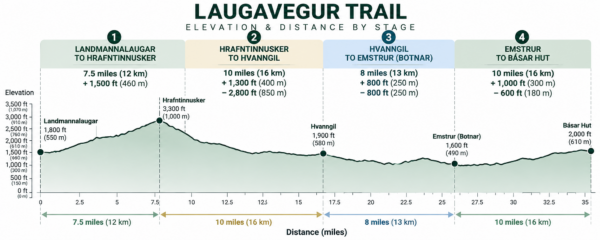
Distances are approximate. Actual mileage depends on the route taken, conditions, and any additional hikes.
On Day 1, we climb approximately 1,500 feet toward Hrafntinnusker, passing colorful rhyolite mountains, steaming geothermal areas, and snowfields.
Day 2 includes one of the trail’s most demanding descents, dropping toward Lake Álftavatn before continuing to Hvanngil.
The descent can be especially challenging for your knees.
On Day 3, we cross black volcanic sand landscapes and glacial rivers on our way to Emstrur.
Our final main hiking stage takes us toward Básar in the Þórsmörk region, including the crossing of the Þröngá River.
Some hiking days can take up to 10 hours, including breaks, depending on the route, terrain, weather, and group pace.
But here’s something that doesn’t show up in the mileage:
The cumulative effect of hiking for several consecutive days.
You might feel great after hiking seven miles at home. But how will you feel after hiking for three or four days in a row?
That’s what you need to train for.
How Do I Train for Laugavegur if I Don’t Live Near Mountains?
I’m from Chicago. We don’t have mountains.
I run, cycle, and lift weights. When I first considered hiking Laugavegur, I’d never completed a multi-day hut-to-hut trek.
You don’t need to live in Colorado or the Alps to prepare for Iceland.
If you’re starting with regular walks on park paths, I’d recommend giving yourself approximately five months to build your fitness, depending on your starting point.
1. Build time on your feet.
Start with distances you can comfortably manage, perhaps five miles, and gradually increase your longer walks.
Work toward longer days of 10–15 miles, and eventually consider a 15–20-mile training walk if your conditioning and recovery allow.
You don’t have to walk 20 miles to qualify for this trek. The point is to develop endurance gradually and learn how your body responds.
2. Train on different surfaces.
Don’t do all your walking on pavement.
Find trails with gravel, grass, mud, sand, rocks, roots, and rolling hills.
Your feet and ankles need experience adjusting to uneven ground.
3. Practice hiking on consecutive days.
Choose a couple of weekends when you can hike something like seven miles one day, ten miles the next, and five miles on a third day.
Adjust the distances to your fitness level.
This helps you understand how your body responds to repeated days of activity, not just one big workout.
4. Strengthen your legs.
I recommend strength training that focuses on your glutes, quadriceps, and the muscles that stabilize your hips, knees, and ankles.
Add hills, stadium stairs, or stair workouts.
Train for the downhill sections, too. Controlled step-downs and other appropriate strengthening exercises can help prepare your legs for descents.
5. Challenge yourself mentally.
Sign up for something that pushes you beyond your normal routine.
Maybe that’s a 5K run, a 32K walk, or a long-distance cycling event.
Thru-hiking takes mental endurance as well as physical fitness.
There will be moments when you’re tired, the weather isn’t cooperating, or you’d rather be sitting somewhere warm.
Learning how to keep moving while recognizing when you need rest is part of the preparation.
What If I’m the Slowest Hiker in the Group?
First, you’re probably not the only woman worrying about this.
We want our group to start together and finish together.
Our local hiking guide leads, and our Green Edventures tour leader stays at the back as the sweep.
When weather and visibility are good, there’s usually room for women to spread out and find their own walking rhythm.
When visibility is poor or conditions become difficult, we keep the group closer together for safety.
Our average moving pace is approximately 1.3 miles per hour, but that doesn’t mean everyone must walk at precisely the same speed every minute.
If someone starts falling behind, we assess what’s happening.
Is she tired? Does she need something to eat or drink? Is her backpack uncomfortable? Does she need to adjust her gear? Or is the trail more physically demanding than she’s prepared for?
Iceland’s long summer daylight gives us flexibility. But we still need to arrive at the huts at a reasonable hour so everyone can settle in, eat dinner, and get the rest they need.
Occasionally, we’ve had participants who couldn’t maintain the pace necessary to complete the route.
In those situations, we’ve helped arrange alternatives, including leaving the trail or using transportation between huts where access and conditions allowed.
Those alternatives aren’t available everywhere, and they can’t be guaranteed.
Our goal is to support every woman while making decisions that are safe for her and the group.
You don’t have to be the fastest hiker. But you do need to be prepared to maintain a reasonable group pace over challenging terrain.
Can I Hike Laugavegur if I Have Bad Knees?
This is one area where I want to be very clear.
Laugavegur is not a good choice for someone with persistently painful or unstable knees.
You will be walking across uneven ground, climbing and descending slopes, stepping over rocks, and crossing rivers.
There are places where you absolutely need to trust your feet, ankles, knees, and hips.
Why spend your vacation in pain?
We require trekking poles on our hikes. They help with stability and can reduce some of the load on your joints, especially during descents.
But trekking poles cannot replace healthy joint function or compensate for significant instability.
If you have a history of knee problems, get an appropriate medical or physical therapy assessment and test your ability on longer hikes with substantial descents before committing.
I want you to enjoy this experience, not simply endure it.
What Do Women Underestimate About Laugavegur?
The weather.
On a blue-sky day, hiking in Iceland’s highlands is absolute bliss.
You have colorful mountains, glaciers, volcanic landscapes, and views that seem to go on forever.
But mountain weather is unpredictable.
It can be sunny, and 30 minutes later you can find yourself in a downpour.
The wind can be intimidating, too. Expect frequent wind and occasionally powerful gusts that can throw you off balance.
Even when the forecast doesn’t predict rain, we carry waterproof rain jackets, rain pants, warm layers, hats, and gloves.
Your clothing is your first shelter in the mountains.
Good equipment isn’t optional.
I also see women underestimate three things:
Hydration. You may be sweating more than you realize, especially when the wind keeps you feeling cool. Drink regularly, replace electrolytes when appropriate, and don’t wait until you’re feeling depleted.
Fueling. Learn what your body needs before you arrive in Iceland. Try different trail snacks during training. Pay attention to how you feel when you need carbohydrates, quick energy, or more substantial food.
Your feet. Feet can swell after hours of walking over consecutive days. Hormonal changes, including those around menopause, can also affect how some women experience swelling.
Don’t assume the hiking boots that fit you in your early 40s will fit exactly the same way in your late 40s or 50s.
Get properly fitted footwear, break it in, and test it on long walks before your trip.
What Happens When I Get Tired After Several Days?
Fatigue doesn’t always look like someone saying, “I’m exhausted.”
Sometimes it’s a slower walking pace, less enthusiasm, irritability, muscle soreness, or withdrawing from conversations.
We prepare women for this before the trip by explaining what to expect and encouraging proper training.
On the trail, we make time for stretching and movement, eat nutritious, replenishing meals, and take breaks.
We also try to keep the atmosphere positive and fun.
Sometimes we even dance.
Our local guides share stories about Icelandic mythology, explain the geology, and introduce us to the plants, wildlife, and natural features along the route.
We’re not racing from hut to hut.
We’re there to experience Iceland.
The hike should be challenging, but it should also be enjoyable.
Who Should Reconsider Hiking Laugavegur?
I love encouraging women to challenge themselves. But I also want them to choose adventures they’ll enjoy.
Laugavegur might not be the right trip for you if:
- You don’t enjoy long days of hiking or being physically uncomfortable at times.
- You’re unwilling or unable to dedicate time to training.
- You don’t want to invest in quality hiking boots, waterproof clothing, and other essential gear.
- You have significant joint pain, poor balance, or physical limitations that make uneven terrain unsafe.
- You’re uncomfortable sleeping in shared mountain-hut dormitories with both women and men.
- You don’t enjoy hiking as part of a group.
- You have dietary requirements that cannot be safely accommodated with the limited food options available in remote mountain huts.
- You have health or vision conditions that could affect your ability to hike safely in remote, uneven terrain without reliable access to immediate medical care.
A chronic health condition or vision impairment doesn’t automatically rule someone out. But it does mean we need an honest conversation about the demands of the trek, appropriate medical guidance, and whether the experience is suitable.
There’s no shame in choosing a different adventure or giving yourself another year to prepare.
My First Laugavegur Hike Changed What I Thought I Could Do
Laugavegur was my gateway into thru-hiking.
I’m from Chicago. We don’t have mountains. I run, cycle, and lift weights, but when I first considered Laugavegur, I’d never done a multi-day hut-to-hut hike.
I’d never done anything like it.
I remember asking my Icelandic friend Kristin Jóná Hillmarsdóttir if she thought I could do it.
Kristin started hiking mountains in her 50s and continued climbing bigger mountains for years.
She told me something I’ve never forgotten:
“Where the mind goes, the feet will follow.”
When I asked, “Do you think I can do it?”
She said, “You can do it.”
She was right.
Now, one of my favorite things about leading women on the Laugavegur Trail is being able to encourage other women the way Kristin encouraged me.
I know what it feels like to question whether you’re capable of something you.

About Tara Short
Tara Short is the founder of Green Edventures, a women-focused adventure travel company she started in 2009. An environmental educator and experienced expedition leader, Tara has been guiding women on Iceland’s Laugavegur Trail since 2021. Originally from Chicago, where mountains are hard to come by, she understands what it takes to prepare for a challenging hike without living near mountain trails. Her passion is helping women discover what they’re capable of through adventure, education, and a supportive community.